

The full answer
Everything else is close to the same: the same free account, the same app, the same row and page for the person you stand with, and the same list of facts on it less five. You can still nudge them, and you can step away whenever you like.
The role, and where it stops
A person using Fold’em has one keyholder and may add up to three other supporters. Everyone in that circle takes part the same way: a free Fold’em account, signed in, with the person on their People tab. There is no lesser tier, no way to take part by letter or in a browser, and nothing you hold that is weaker than what the keyholder holds except the key itself.
That boundary is enforced on the server rather than in the wording. Only the keyholder's phone can show the code that agrees to end protection, and only the keyholder can say no. A supporter without the key has neither: their app draws no code and no decision for that person.
What you see
You see items 1 to 3 and 7 to 9 of what a keyholder can see, from the same view of the person. Four things travel with the key. An open request to end protection, because only the keyholder answers it. The wait to turn off Deletion delay, which only the keyholder sees: by name in their History of the person, or on the person’s status page on the Fold’em website, and with no notification. A handover, which reaches the current keyholder and the person being offered the key and nobody else. A request to end a Lockdown sooner, with any note that comes with it. One more is the keyholder's alone: a notice, once, if they close their account.
You see what a request to end protection leads to, never the ask. While one is in its wait, their row reads Can end it and the moment the wait ends, and if protection ends it reads Protection ended.
Everything a keyholder never sees, you never see either. No check ins, no goal, no Money kept, no apps, no sites, nothing browsed, nothing anybody typed, and nothing about Lockdown, because none of it has a carrier.
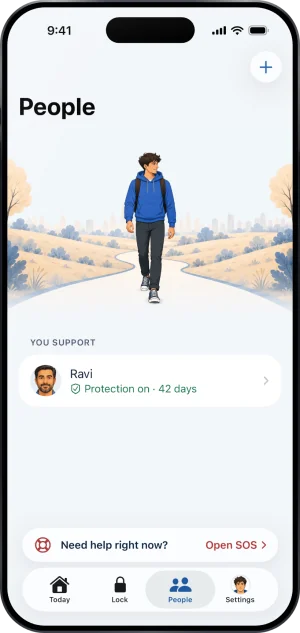
Their row, and never their request
How things reach you
The person's row carries the standing picture, and what needs you arrives as a notification: an ask for support, a milestone day they reached, protection going off or their phone going quiet, and protection that is ending. These reach the keyholder and every supporter alike. The request to end protection itself belongs to the keyholder alone.
Some of these you choose, in Settings › Notifications in your own app: Milestones and Protection ending each have a switch, and those switches are private: nothing about them reaches the person you stand with. The rest have none. An ask for support, protection going off and a phone gone quiet reach you whatever you set, and so does a request, which for you means a handover that offers you their key. The way to stop hearing from someone altogether is to step away.
If they switch the gambling free run off, their row for you stops showing the count, their page reads Not shared, and both still show whether protection is on.
Living with their row
-
Read the row for the state
The same row a keyholder reads, minus the request. Their page says which of the two you are, You support and their name, or You hold their key, and the foot of You support names whose key you hold.
-
Send a nudge, sparingly
Encourage, on their page, sends one of three fixed encouragements, Thinking of you, Proud of you or You got this, with no words of your own and no way to send words. There is a small daily budget per person and a gap enforced between nudges, so the channel cannot become a stream. Calling them is a separate act and spends none of it.
-
Step away if it is not for you
Stepping away removes your link and nothing else. No flag is written and nothing about their way to end protection moves, so their protection is exactly as it was a moment before.
If the row looks still
A still row is a quiet week, not a fault: a fault has its own word on the row. The day count is worked out on your own phone from the date it carries, so a row that has not synced today still counts today. Offline, the app says so at the top of People and shows the last copy your phone kept rather than pretending to be live.
If a person disappears from You support entirely, the arrangement ended: they closed their account, or they removed you. There is nothing to repair on your side.
What this does not do
Being a supporter without the key gives you no authority of any kind. You cannot answer a request, cannot end their protection, cannot change their protection or their blocks, and cannot change what anybody else is told. Nothing about their protection depends on you, and nothing changes about it when you leave.
The role also does not scale into a keyholder's by accumulation. A person has exactly one keyholder. If nobody holds their key, they can send you a link that asks you to hold it, and you answer it in the app.
Write to us and a person reads it. We answer within two working days, and we would rather hear the question twice than not at all.