

The full answer
The one thing it deliberately cannot keep is what you blocked: the apps and categories you picked are Apple opaque tokens that stay on the phone and are unreadable even to us. There is no advertising, no advertising tracker and no analytics broker in the app, and nothing is sold or shared for marketing. Crash reports and the push token for notifications are kept with your account too. What a keyholder can see is a narrower list again, and it is written out in full on its own page.
What is on the server
Seven things, and the reason for each is that the lock cannot work without it.
Your account: the identifier Sign in with Apple returns, plus your name and email if you chose to share them, and the character you chose, which is the face the people in your circle see for you. Your exclusion: your protection and the day it started, and how many things you blocked as plain counts such as twelve apps and ten websites. Your keyholder arrangement, if you have one: the link to their own signed in Fold’em account, which is where their name comes from, and which is how an invite, a request to end protection and anything about your protection reaches them. Your keyholder's first name, shown to another keyholder: when you hand the key from one person to another, each of them is told the other's first name, because a handover neither of them can see is not one they can consent to. Your protection status: periodic readings from the phone saying whether blocking is still active, which is what lets anyone holding your key be told when it is not. The deletion delay: whether it is on, and whether its release has been started. And your requests to end protection with their decisions.
Five more things are kept with your account. A Lockdown end request, if you ask your keyholder to end a Lockdown sooner: the request, when the run would end on its own, any note you write, and their answer. The push token your phone is given for notifications. A crash report, if the app crashes, which goes to Firebase Crashlytics with your account identifier and is kept for 90 days. Any problem report you send, kept for 180 days. And your invite code, with which accounts redeemed it.
What site blocking sends
With site blocking on, your phone sends every address lookup it makes, in any app, to Fold’em’s resolver at dns.foldem.app, which runs on Fly.io in Ashburn, Virginia, in the United States. It answers a gambling address with nothing and passes the rest on. It is not given your IP address and keeps no record of the names it answers; its service log of starts, restarts and errors is kept for 7 days. The privacy policy says it in full.
What never leaves the phone
The exact apps and categories you blocked never reach the server, and this is a property of Apple's Screen Time technology rather than a promise we made: the picker hands the app opaque tokens that are meaningless outside the device that made them. Nobody at Fold’em can read your blocklist, and neither can your keyholder.
Four more things stay local by design: your daily check ins, your self reported weekly spending baseline, the money kept figures worked out from it, and your Lockdown schedule. Money kept is computed on the phone and never leaves it, which is why no dollar amount reaches a supporter anywhere in the product.
What Fold’em never does
No advertising, no advertising trackers, no analytics brokers. No selling or sharing of data for marketing, to anyone. No reading of your browsing history: site blocking answers address lookups and keeps no history of them. Subscriptions are processed by Apple, so payment details never reach us; Apple tells us whether a subscription is active, when it ends and whether a payment was refunded. The app runs on Google Firebase for sign in, database, hosting, notifications and crash reports, runs site blocking's resolver on Fly.io, uses Resend in the EU region to deliver email, uses PostHog in the EU region to keep anonymous usage counts, which you can turn off in Settings, and uses Cloudflare for the foldem.app domain and its support email; each acts only on our instructions.
What a keyholder sees is narrower still
Everything above is what the service holds. What actually reaches another person is a much shorter list: a first name and a chosen character, whether protection is on, day counts and dates, milestones, and the type and count of events. Never an app, never a site, never an amount, and nothing you typed except a note you add when you ask your keyholder to end a Lockdown sooner. The list is written out one by one in What does my keyholder see?, which is where to look if that is the question you came with. A supporter without the key sees a subset of it, named on the same page.
Checking it yourself
-
Open Settings, then What your people see
The page draws your card as the people in your circle see it right now, and under it the one switch that decides what is shared, set once for everyone.
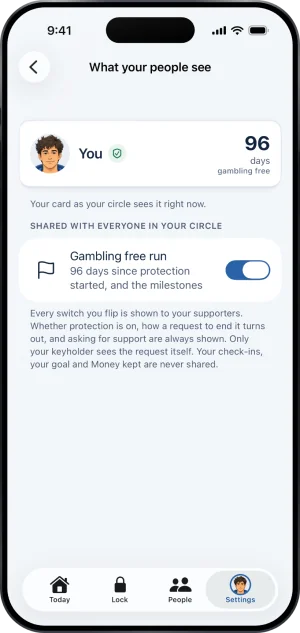
What your people see, set in Settings
-
Read what is never shared
Under the switch the page says what is always shown, whether protection is on, how a request to end it turns out and asking for support; that only your keyholder sees the request itself; and what is never shared: your check ins, your goal and Money kept.
What this does not do
Fold’em cannot show you a list of the apps you blocked, because it cannot read one. It cannot tell you which site you tried to open, for the same reason. It does not hold your payment details, and it cannot answer a question about a charge. A keyholder's account belongs to them, not to you, and cannot be changed on their behalf from inside the app. Data is kept while the account exists and is removed when the account is deleted, so there is no separate button that erases your history and leaves you signed in.
Write to us and a person reads it. We answer within two working days, and we would rather hear the question twice than not at all.