

The full answer
In the Fold’em app, saying no is one tap after Face ID, and it is the easy choice on purpose; to agree, the app shows them a code after Face ID, and you scan it with your own app while you are together. A keyholder who joined by email before 3.0 says no on the page their letter links to, and shows the code from their Wallet card. If they answer nothing for seven days the request closes, and their agreement starts a wait of 48 hours.
Two decisions, and they are not symmetrical
When your request opens, a keyholder who uses the Fold’em app finds it red and first among the people they support on their People tab, whatever their notification switches say, and answers there, from the account they are signed in to, so nothing forwarded to anybody else can answer in your name. A keyholder who joined by email before 3.0 gets a letter from hello@foldem.app, says no on the page it links to, and shows their code from their Wallet card.
On that page there are exactly two controls, and they are not equal. Say no is the primary button, and it is the one that changes nothing: your protection carries on as it was. Under it, Show my code is the quieter one, and both ask for Face ID before they do anything. The page states the point in one line under your name: to say yes, they show you their code in person.
Agreeing is meant to be done together. After Face ID their app shows the code, valid that day only, with the line Show this in person. Do not send a screenshot. It is never printed on any web page, and it never reaches the copy of the request your own phone can read. You scan it with the scanner in your app, and the scan is checked against your open request. Fold’em cannot check that you are together: the code works for up to a day, so a photo of it would scan too. That is why the app asks them to show it only in person, and why there is no button anywhere that agrees for them.
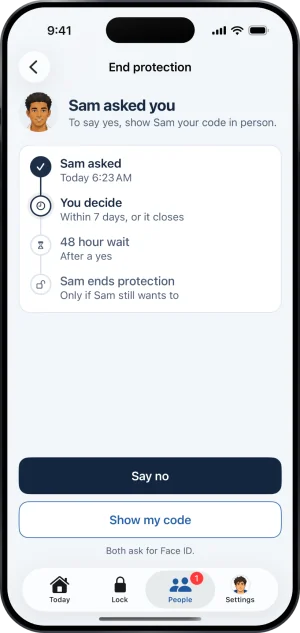
The keyholder's page, on their phone
Silence closes the request
Your keyholder has seven days to answer. Their page says so: they decide within 7 days, or it closes.
If that date passes with no answer, the request closes. Nothing is granted, no wait starts, and your protection carries on exactly as it was. Silence is not a slow yes and it is not a route around the person you asked: waiting a keyholder out gets you nowhere at all.
What their agreement starts
An agreement does not end your protection. It starts a wait of 48 hours, counted from the moment your scan lands, and at the end of that wait the server marks the request ready and stops there. Nothing about what is blocked has moved at any point in this, and ending protection is still something you have to do.
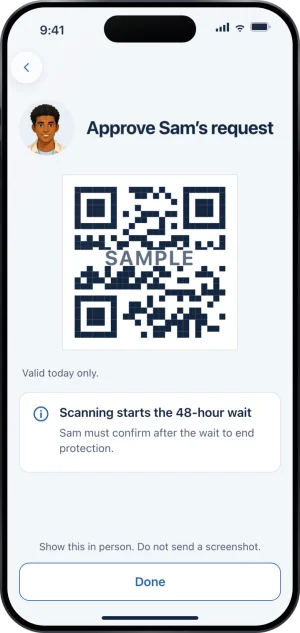
The code, shown in person
What your keyholder cannot do
They cannot agree with a button. The only answer they can give from their own phone is a refusal. There is no version of the app, no link and no web page that agrees for them, and support has no such control either: the one way to agree is the code, scanned by your phone.
They cannot cancel or shorten the wait once it starts. The rules on the server allow only you to touch your own request, so an agreement they gave cannot be taken back by them, and the 48 hours cannot be trimmed by anybody.
What is shared is set once; what reaches their phone is theirs. One switch in Settings, under What your people see, decides whether your gambling free run is shown to your circle; everything else a keyholder sees is a fixed list. They choose some of those things as notifications, in their own app. A request reaches them whatever those switches say: in the app, or by letter for a keyholder who joined by email before 3.0.
They cannot see what you are blocking. Not the apps, not the sites, not any amount of money, and nothing you typed except a note you add when you ask them to end a Lockdown sooner. The full list of what they see is written out one by one, and that is all of them.
The same decision described from the keyholder's side, before they have to make it, is in someone you love is gambling.
What this does not do
A decision here does not change what is blocked on your phone, and it does not touch your gambling free count, which runs from your last bet whatever anybody decides. A refusal carries no reason and does not turn into an agreement by being waited out; you can ask again after 48 hours, and a long run of nos has a limit, set out under if they say no. An agreement does not end your protection: it starts a wait, and at the end of that wait ending protection is something you do, not something that happens to you.
Write to us and a person reads it. We answer within two working days, and we would rather hear the question twice than not at all.