

How to ask them, and when they ask for the key back
Ask for something narrow and now: that the next bad night should cost a conversation instead of a thumb.
Updated October 2026
The ask
You are not asking them to stop, to explain, or to promise. Those asks land on the person, and the person is already carrying it. You are asking for one small structural change: that ending the block takes a conversation with you instead of a tap they can make alone at one in the morning.
Three things help it land.
- Be specific about what you get, and about what you do not. Say it out loud, because they will assume the worst. You will not see which apps or sites were involved. You will not see their browsing. You will not see any amount of money, and there is no amount of money anywhere in what reaches a second person. If it helps, send them the page that lists what a keyholder is shown and let them read it themselves rather than taking your word for it.
- Be specific about what you would have to do. Answering, and only if they ask for it. If they ask to end protection, to end a Lockdown sooner or to pass the key on, you answer. That is the role, in full.
- Let them set the terms. They choose which apps and sites to seal. A block they designed is one they can defend to themselves at four in the morning. A block imposed on them is one they will spend that hour arguing with.
What not to do: do not set anything up on their phone without them. The app's setup does ask them about a Screen Time passcode: someone they trust sets a passcode they never see. Where iOS supports it, loosening their protection later goes through that person. If that is you, recovery is on your own Apple Account, not theirs, and Fold’em never sees the code.
The first week, so you are not surprised by the quiet
When nothing goes wrong, holding a key is almost silent. You use Fold’em on your own iPhone, signed in, and the card you hold for them sits there showing that their protection is on. Which kinds of alert ring your phone is yours to set in your own Settings.
The card changes if protection goes off, if the phone stops confirming for 24 hours, or if protection is ending. A request to end protection, or to end a Lockdown sooner, is what you answer rather than simply read, and it always reaches you whatever your switches say. What reaches you and what does not sets all of it out.
The day they ask
It may happen, and it is not a failure of the arrangement. It is the arrangement working: the thing that used to take a thumb now takes you.
The request reaches you in your app, with a date to decide by. Nothing about their phone changes while you are deciding. There is no message from them attached, because a request to end protection carries no text field in either direction, so you are answering the request and not a paragraph written at midnight.
Saying no
One tap, from anywhere, in your own app. Your phone confirms it is you before the tap counts.
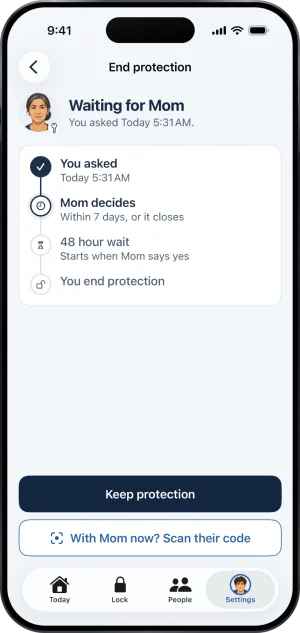
What they see when they ask you
If you say no they are told, with no reason attached, and the request closes there. A denial is a denial. You do not owe an explanation and there is nowhere to write one. They can ask again 48 hours later, which starts a fresh request rather than reopening this one. Saying no is the easy choice on purpose: it is one tap, it changes nothing, and it is the answer that leaves the world as it was.
Saying yes, which cannot be done at a distance
No web page and no email can let somebody out. It is only ever done in person: your app shows an approval code and they scan it with the app on their phone, while the two of you are standing together.
That is not friction for its own sake. It is the difference between a decision made in the room and one made by a tired person tapping a link, and it is the single feature most worth understanding before you accept a key.
Even then nothing opens that day. Scanning the code records your agreement and starts a wait of 48 hours from the moment you said yes. When it ends, the server marks a release they still have to take, and holds it for seven days before it closes again unturned. After a request, nothing opens by itself.
The two facts to know before you accept
Both of these are easy to get wrong, and both of them make silence a worse answer than an honest one.
- Seven days of silence closes the request. If you do not answer, the request closes on its own and their protection carries on exactly as it was. Silence is not a yes, and it is not a no you have to defend either; it simply runs the clock down while they learn nothing. Both answers stay open for the whole of those seven days, and nothing about their phone changes during them. Not deciding is still a decision, and it is the one that leaves them waiting.
- A subscription that ends opens the block without any request. If their subscription ends, protection stays on for 72 hours, then ends unless the subscription is restored. Their card reads Protection at risk, and you are told that protection is ending. It is the one way out that is not a request, and it is deliberate rather than a hole.
Neither of these is something you can change. You cannot shorten a wait, cancel one, or end their protection yourself. What you can do is answer when you are asked.
If you want to stop holding it
Handing the key back is supported from your own app, except while a request of theirs to end protection is open or a handover is in flight, and it is better than holding a key and never opening it. It takes effect at once: their protection continues with nobody holding the key, and from that moment ending protection takes seven days from the request rather than a decision from anybody. You confirm it before it happens.
Saying yes to a key and later finding it too heavy is allowed for, which is why the way out is built in. It is not a betrayal to use it.
The help center answers how the app behaves, screen by screen. If your question is not there, write to us. A person reads it and answers within two working days.
If you need someone now
Free, and not run by Fold’em.
- Call 1 800 697 3738National Problem Gambling Helpline, US. Call, text or chat.
- Call 1 866 531 2600ConnexOntario, Canada. For people in Ontario.Website for ConnexOntario
- Call 0800 1 37 27 00BZgA Check dein Spiel, GermanyWebsite for BZgA Check dein Spiel
- Call 1800 858 858Gambling Help Online, AustraliaWebsite for Gambling Help Online
- Call 0808 8020 133National Gambling Helpline, UKWebsite for the National Gambling Helpline
- Other countries
Gam-Anon is a community for people supporting someone who gambles.