How does leaving early work solo?
Updated September 2026
Solo means nobody has accepted your key, so there is nobody to ask. The request approves itself the moment the server writes it down, and a wait of fourteen days starts from that instant. The wait is the whole of the friction: it runs on the server, your phone cannot shorten it, and every app and site you sealed stays sealed for its entire length. At the end the server marks a release, and the apps open when you take it.
What counts as solo
Solo is not a mode you switch on. It is simply the state of having no keyholder who has accepted, and the server decides that at the moment your request lands rather than from anything stored on the phone. Four situations all read as solo: you never invited anyone, the person you invited has not accepted yet, they declined, or their invite expired. A witness does not change it. Witnesses see status and never hold the key, so a user with three witnesses and no keyholder is solo for the purposes of an exit.
Two later events also put you here. If your keyholder steps away, or if you remove them, the account returns to solo for the rest of the term. Neither is a shortcut: both write a floor of fourteen days onto your term at that moment, so any exit that follows can never end sooner than fourteen days after the change, whatever else happens.
The request approves itself, and then you wait
With nobody to ask, there is no decision step to run. The server opens the request, sees no accepted keyholder, and immediately marks it approved with a wait of fourteen days counted from that moment. The app is honest about who did it: the middle step of the process reads Approved automatically, with Nobody holds your key under it, and the last step reads 14 days after your request. No name and no face is drawn on a step nobody stood at.
The fourteen days are the whole of the friction, and they are not negotiable from the phone. The deadline is stamped by the server, the count on your screen is a reading of that stamp, and turning the phone off, changing its clock or reinstalling the app moves none of it. Every app you sealed stays sealed, the site list stays blocked, and the deletion lock stays exactly as you set it, for the entire fourteen days.
A keyholder who never answers ends up on this same road. If somebody does hold your key and says nothing for seven days, the request approves itself as though you had no keyholder at all, and the wait after that is the same fourteen days. That is the one case where having a keyholder and having none end in the same place, and it is why waiting somebody out is never quicker than asking them.
Asking, solo
-
Settings, then Term & money
The solo door is a row called End protection early, drawn in the destructive style, in the Term & money section of Settings. It is drawn only for somebody with no accepted keyholder and an active term; with a keyholder, the door is on their page in Circle instead.
-
The form says fourteen days before you slide
The block headed Before you slide names the days left on your pledge and states the length of the exit, and on the solo path it says fourteen days rather than 72 hours. Once the request exists, the process sheet stops reading your phone at all: it takes solo or partnered from the server's own record of who was asked, so the words on the rail are the server's answer and not the phone's guess.
-
The rail shows three steps and no decider
The process opens with the request stamped, the automatic approval in the middle, and the apps opening last. On Home the safe reads EXIT REQUESTED, and while a solo request is only waiting no card is drawn under it; the card comes back when the wait is counting.
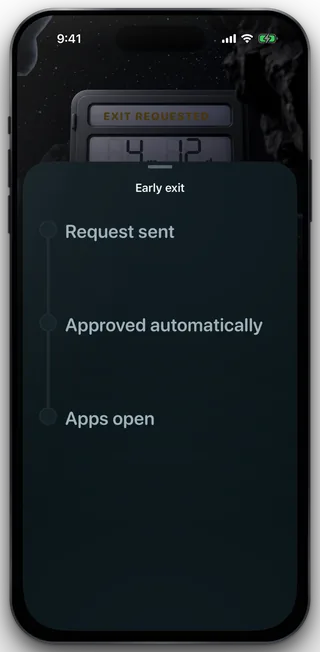
The solo shape of the exit sheet
-
Cancel it at any point, or take the release at the end
Cancelling is yours alone and stays available for the whole wait, including after the release exists. If you let the wait finish, the release is held for seven days and the apps open when you take it.
What this does not do
Being solo does not make the block weaker, and it does not make leaving easier. It removes the person, not the wait, and the wait it leaves behind is longer than the one an approval buys. Inviting somebody in the middle of an open exit is refused rather than allowed, so a keyholder cannot be added as a way to shorten a request already running. Removing a keyholder does not shorten anything either: it raises the fourteen day floor and, for the rest of that term, no new keyholder can take over. And solo changes nothing about what is blocked, on this phone or any other: it is only the answer to who is asked.
Still stuck? Email support@foldem.app and we answer within two working days.