Why can I not invite while an exit is open?
Updated September 2026
Because an open invite and an open exit make each other into lies. The invite asks somebody to start holding your key; the exit is you ending the arrangement that key belongs to. Fold'em allows only one of the two at a time, in both directions, and rather than hiding the control it leaves it in place and names what is in the way. Cancelling whichever one you no longer want lets the other one through immediately.
Why the two cannot both be open
An exit request tells you that nobody holds your key, or that the person who does is being asked to let you out. An invite tells somebody else that you want them to start holding it. If both are open at once, each makes the other's words false: your exit says the relationship is ending while the invite promises it is beginning, and the person accepting has no way to know which is true.
So the rule is one at a time. It covers every invite role, keyholder and witness alike. It was first drawn to cover keyholders only, and was widened deliberately, because a witness invite that lands mid exit still puts a new person in your circle in the middle of you leaving.
The rule is enforced on the server in both directions, so it holds even if two devices race each other. The invite side refuses to mint a link while an exit is open, with a refusal you can read rather than a generic failure. The exit side closes a request that arrives while an invite is still out. Nothing is silently swallowed, and neither refusal changes anything about what is blocked.
Two blocks, two different shapes
The two halves are deliberately not drawn the same way, because the honest answer differs.
An exit running turns the invite doors inert. Add a keyholder on the Circle root, and the witness places beside it, stay exactly where they are and stop responding, with one amber line under them naming the cause and the act that lifts it: not while an early exit is running, cancel the exit to add one. A control that vanishes teaches nothing about why it went, so it stays and explains itself.
An invite out does not make the exit door inert, because a dead end where the way out should be would be worse. The entry stays live, and a screen stands where the request form would be. It lists the invites that are in the way, with the role and how long ago each was sent, and it offers one action across all of them.
Calling the invites off
The action is collective on purpose: cancelling one invite closes every open invite of that role rather than picking one out of a list, so the screen is a list you read and not a list you choose from. It confirms through the same alert the Circle uses for cancelling an invite, and that alert names exactly what it is about to close. Where a keyholder invite is in the set it also says you will continue solo; where only witness invites are in the set it does not, because a witness has nothing to do with who holds the key. Either way it ends with the sentence that matters most: your blocking does not change.
If part of it fails, the app says which part. A complete failure says nothing changed; a partial one says the invites still listed are still out, and the list itself is the evidence. And an invite you simply leave alone clears itself: an invite link lives 72 hours from the moment it is sent, and the invite expires with it.
What you see, and what to do
-
The Circle root explains the inert place
The keyholder place is still drawn, still labelled Add a keyholder, and does not open. The line under it names the exit as the cause and cancelling it as the fix. The witness place below behaves the same way.
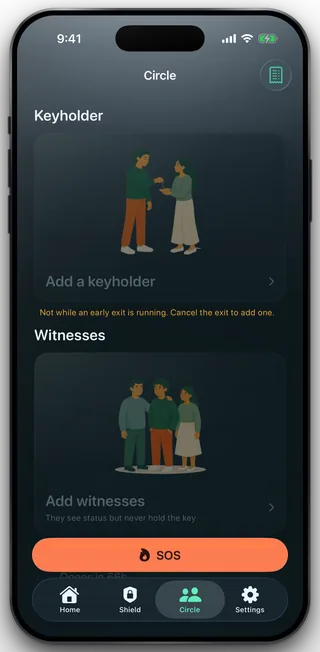
The invite door, while an exit runs
-
Cancel the exit if the person matters more
Cancelling an exit is one confirmation and changes nothing about the block. The moment the request closes, both places open again and the invite goes out normally.
-
Or call the invites off if the exit matters more
Coming the other way, take the exit door as usual and the block screen stands in front of the form. Read the invites listed, take the call off action, confirm, and the request form is there behind it.
An open exit also pauses two other things
The same reasoning covers the rest of the circle. While an exit is open, handing your key to somebody else is refused with the same reason, and a keyholder trying to step away is refused too. Both would change who decides your request while your request is being decided. Resolve the exit first, either by cancelling it or by letting it finish, and both become available again.
What this does not do
None of this weakens or strengthens the block: every app and site stays exactly as it was through all of it. Calling off an invite does not remove a keyholder who has already accepted, and it does not touch a witness who is already in your circle; only invites that were never accepted are closed. Cancelling an exit does not shorten your term or undo the days you served. And the rule blocks new things only. If you already have an exit and an invite open at the same time from before, neither is hidden and neither is deleted: what you see is the truth, and either one can be closed by hand.
Still stuck? Email support@foldem.app and we answer within two working days.