How are my days counted?
Updated September 2026
Home carries two counts and they answer different questions. The safe's readout is your term: it counts down on a fixed term and up on an ongoing one. The Gambling free card is your run, and it starts at your first commitment rather than your current term, so a term ending, a new term starting, an early exit, a payment lapse and a Screen Time revoke all leave it running. The one thing that resets it is you saying you gambled.
Two counts, two questions
The number inside the safe is the term. It is labelled TIME LEFT on a fixed term, where it counts down to the end date you picked, and TIME HELD on an ongoing one, where it counts up because there is nothing to count toward. It flips to TIME HELD on the day a fixed term reaches its end, so it never renders a hard row of zeros.
The number on the Gambling free card is the run, and it belongs to you rather than to a term. It starts at the instant your first commitment was born, or at your most recent admission if you have made one, whichever is later. That is the only pair of inputs it has: nothing a term does is one of them.
Reading them
-
The safe and the card
The seven segment readout under the status word carries two fields and a caption naming which count it is. The pair of tiles below the safe is the ledger: money taken back on the left, Gambling free on the right, showing the run in two units.
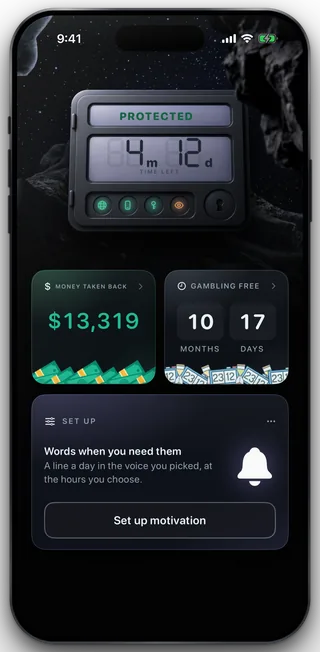
The two counts on Home
-
The whole run, place by place
Tapping the Gambling free tile opens the run in full: years, months, days, hours, minutes and seconds, one row each with the date it started above them. A zero place is still printed, because a zero year on a nine month run is the true value of that place and hiding it would be a different claim.
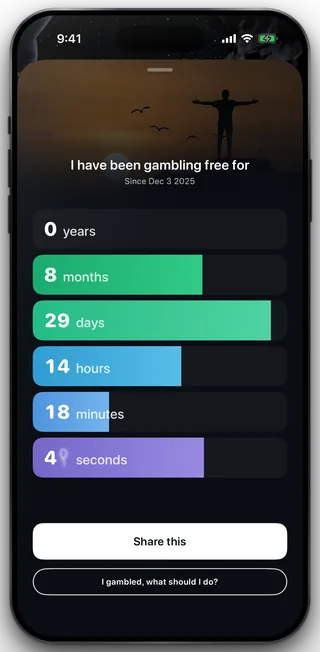
The run in full
Calendar days, not arithmetic
Every value comes from the calendar rather than from dividing seconds. A month is the month you actually lived through, whether it ran 28, 29, 30 or 31 days; a year absorbs its leap day; and a day on which the clocks changed counts as one day whether it ran 23 hours or 25. Dividing by 30 gets all four of those wrong, and it gets them wrong in the direction that overstates a run.
The two units you see are picked by size, on one ladder the run and the TIME HELD readout both use. Under an hour it reads minutes and seconds; under a day, hours and minutes; under 60 days, days and hours; under a year, months and days; past a year, years and months. A TIME LEFT countdown is the one reading that does not climb that ladder: it is always months and days, because it is measuring toward a date rather than describing a span. The sheet's rows and the card's two tiles are the same span asked at a different resolution: the card names the two largest units, the sheet names every place under them, and both borrow the same two instants through the same calendar, so they cannot disagree about the run.
The one reset
Nothing in the product resets the run except your own admission. The Gambling free sheet carries a quiet second button asking what to do if you gambled, and the sheet behind it offers local support, more layers to stack, and then the reset, which confirms once before it happens. The app states its own limit there in plain words: your counter and your milestones start over, and your term, your blocking and the money you have taken back are untouched.
The reset is display only. It cannot lift a shield, end a term, shorten a wait or reach the server's authority over any of them.
What survives a reinstall
The anchor is mirrored to your account, so signing back in on a new phone restores the run rather than starting it again. A reinstall with no network falls back to the current term's start, which understates the run rather than inflating it, and it heals itself on the first successful read: the earlier of the two instants wins, and the merge can only ever walk backwards.
What this does not do
Neither count is evidence about the world. Fold'em can see that this phone was blocked; it cannot see a second phone, a desktop, a betting shop or cash, so a run is a record of what you committed to and kept, not a proof that no bet was placed. Neither count gates anything: no shield lifts and no wait shortens because a number reached a value. And the run is not your term, so reading it will not tell you when a fixed term ends.
Still stuck? Email support@foldem.app and we answer within two working days.