How is money kept worked out?
Updated September 2026
The figure is your own weekly stake divided by seven, multiplied by the whole days since your run started. Fold'em has no access to your bank and measures nothing: the weekly number is one you gave it during setup, and you can change it at any time. The receipt on the money sheet breaks the same figure down by month, and the rows add to the total because both come from one calculation. No amount ever reaches your keyholder or your witnesses.
The whole calculation
Money taken back is a daily accrual: the weekly figure you named, divided by seven, multiplied by the number of whole calendar days since your run began. That is the entire method. At a weekly boundary it comes to exactly the weekly figure times the number of weeks, and between boundaries it grows a day at a time so the number visibly moves.
It counts from the birth of your first commitment, never from your current term, so a term ending or a new term starting does not reset it. Saying you gambled resets your counter and your milestones and deliberately leaves this figure alone, so the two dates part company from that day on: the days you already held are still days you did not spend.
The number it multiplies
-
You name the weekly stake
Setup asks what gambling cost you in a typical week, and that question cannot be skipped, so the figure is always one you gave rather than one Fold'em guessed. The sheet offers four common amounts and a field for anything else, and it says plainly that an honest guess is enough. The same sheet is how you set it later if you never had a figure to give.
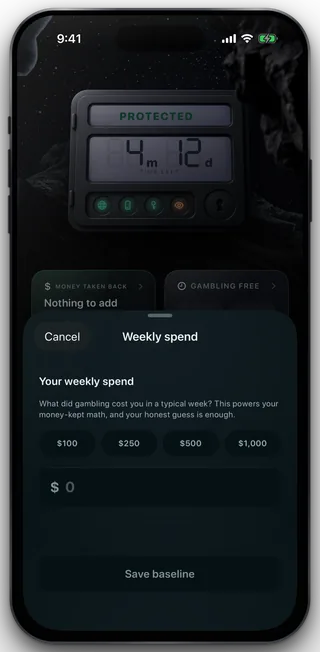
Naming the weekly stake
-
The money sheet shows the working
Tapping the money tile on Home opens the total, the date the run started and the number of days, then the weekly rate with a minus and a plus for changing it, and under that a paper receipt itemised by month. Four months show at a time and the rest are one tap away. Change the weekly rate and every row and the total move together, because they are one calculation and not two.
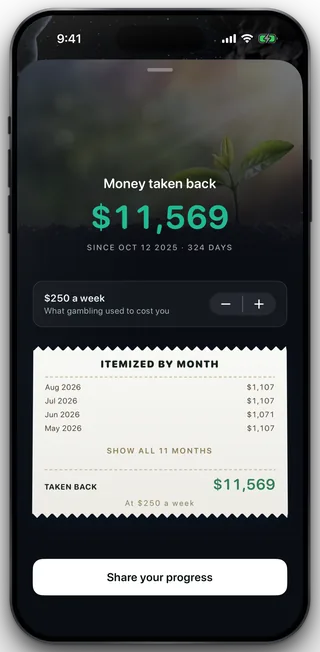
The receipt
Why it is an example and not a measurement
Fold'em connects to no bank, no card and no operator account. It cannot see a deposit, a withdrawal, a win or a loss. So this figure is not a claim about what you would have lost; it is your own stated rate applied to time you can prove you held, and every input to it is visible on the sheet that renders it.
It is also not an average of anybody. There is no typical user figure anywhere in the app, because the number comes from a value each person sets and there is no distribution to average over.
Your keyholder never sees an amount
No dollar figure reaches a keyholder or a witness through any channel. Not the Wallet pass, not the emails, not the web status page. The money you have taken back is yours to read and nobody else's, and what a keyholder can see is a short, fixed list that has no money on it.
What this does not do
The figure changes nothing. It gates no shield, ends no term, shortens no wait, and it is never an input to what your phone blocks. Editing the weekly rate rewrites the display and touches nothing else, in either direction. And because it multiplies a rate by days rather than watching your money, setting a stake far above or below what you really spent produces a number that is exactly as wrong as the stake you gave.
Still stuck? Email support@foldem.app and we answer within two working days.